• Thank you for visiting HeavyEquipmentForums.com! Our objective is to provide industry professionals a place to gather to exchange questions, answers and ideas. We welcome you to register using the "Register" icon at the top of the page. We'd appreciate any help you can offer in spreading the word of our new site. The more members that join, the bigger resource for all to enjoy. Thank you!

CAT 972m

MFM Truck&Equipment

Active Member
Joined
Sep 19, 2024
Messages
43
Location
Ontario
CAT 972m

LSJ02619 serial number

Active code 2500-3
Powertrain speed range control position sensor voltage above normal

Scanned with cat et, only code active or logged is 2500-3. Using my "modified SIS" it looks like this code is related to the thumb wheel on the left joy stick for manual shifting. (no steering wheel). I couldn't find specific step by step trouble shooting for this code. My SIS is showing the same trouble shooting for all PWM sensors on the transmission. I performed all the trouble shooting with the expectation of pulse width modulation on the multi meter. Wasn't able to get that feature to function on my meter. Everything checks out good. All pin to pins and voltage checks are spot on.The end of the trouble shooting is to perform a calibration on the sensor. I do not see an option in et to calibrate the thumb wheel. I couldn't find a straight answer in SIS that this code is for the thumb wheel. All I was able to find was on the machine schematic pin 40 for the transmission controller is labeled speed range thumb roller. If someone with the SIS experience could confirm I'm on the right path that would be greatly appreciated.
 

Nige

Senior Member
Joined
Jun 22, 2011
Messages
38,642
Location
G..G..G..Granville.........!! Fetch your cloth.
I performed all the trouble shooting with the expectation of pulse width modulation on the multi meter. Wasn't able to get that feature to function on my meter.
Do you mean your meter is not capable of measuring duty cycle.?
if that is the case then you need to get hold of one that does otherwise it will be impossible to perform the troubleshooting.

The troubleshooting procedure is a "catch all" document, "Sensor Signal (PWM) - Test". It's designed to be used in conjunction with the electrical schematic for the machine.

I assume you downloaded a copy of the full Electrical Schematic for the machine - M0099493.? It will be easier to follow than the abbreviated (and fuzzy) schematic on the trobuleshooting procedure.

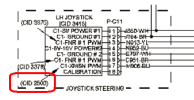
The snip below is key. It shows the CID2500 as being caused by the signal (or lack of it) on wire M906-BU for the speed range thumbroller. That wire does indeed go to Pin 40 of the Powertrain ECM. It also goes through a couple of major wiring harness connector en route, it might be an idea to take a look at them to check for the presence condensation/contamination/corrosion.

1746060881392.png
 

MFM Truck&Equipment

Active Member
Joined
Sep 19, 2024
Messages
43
Location
Ontario
Sorry for the extremely late reply. Yes I am using diagram #M0099493. All wiring has checked out okay as per specs on the catch all trouble shooting. The harness seems relatively short. From the left joy stick to the TCM behind the operators seat. Resistance is still perfect when performing the wiggle test on the harness. I did inspect a few connectors, no visible faults. I'm definitely leaning towards a faulty switch. When I get a chance to get back to the site I'll bring a different meter with me to perform the PWM test. I will keep you posted.
 

Nige

Senior Member
Joined
Jun 22, 2011
Messages
38,642
Location
G..G..G..Granville.........!! Fetch your cloth.
Resistance is still perfect when performing the wiggle test on the harness.
Can I suggest a different way to test the wires in the harness.
There have been plenty of cases on this forum (one only last weekend) of significantly damaged harnesses where a wire gave good numbers on a resistance check leading to the conclusion it was "good". The truth was something else entirely with most of the individual filaments in the wire broken and what was left literally "hanging on by a thread" and therefore not fit for purpose to pass current or a signal as in this case.

The most reliable form of testing I have come across in these circumstances is first to disconnect the harness containing the wires you want to test at both ends. Then to test a particular wire connect one end of said wire to machine frame ground. To the other end of the same wire connect a fised 5A test light from battery+. The thinking being that is the wire will pass 5A without going pop it can probably be considered as being good.
 

MFM Truck&Equipment

Active Member
Joined
Sep 19, 2024
Messages
43
Location
Ontario
That's a technique I'm familiar with. I carry a 12v and 24v head lamp on the service truck just for load testing circuits and proving a wire is good. I'll double check the circuit when on site.
 

Nige

Senior Member
Joined
Jun 22, 2011
Messages
38,642
Location
G..G..G..Granville.........!! Fetch your cloth.
Referring back to the last one only a few days ago, the wire in question measured 0.3 ohms when checked with a multimeter. When the harness was finally examined only about 10% of the strands were still connected, the rest were broken.
 
Top