• Thank you for visiting HeavyEquipmentForums.com! Our objective is to provide industry professionals a place to gather to exchange questions, answers and ideas. We welcome you to register using the "Register" icon at the top of the page. We'd appreciate any help you can offer in spreading the word of our new site. The more members that join, the bigger resource for all to enjoy. Thank you!

Goodall Jump packs

LCA078

Senior Member
Joined
Sep 29, 2019
Messages
726
Location
Austin, TX
The battery pack is not the same, it has at least half again as much battery as the 12 V version.
I'll split it with ya as I think we're both right as much as we're both wrong. I was looking at the specs on a random website so I decided to download the actual brochure for better info. I stand corrected as the brochure says the 12V battery is 236.8 Watt-hours while the 12V/24V is 296 Watt-hours. This means the 12/24v battery is 25% "larger" even though the max power output is still the same as the 12v version, pretty much right in between what you and I were saying.

But on the flip side, I'm in real awe that a piddly 296 Wh battery can produce that much 'oompf'. I use military 12v/24v li-ion batteries in my shop and a 298 Wh is standard size for a SINGARS radio battery. https://www.bren-tronics.com/bt-70791jv.html. That's pretty impressive a 3lb battery can crank a decent sized diesel.
 

Attachments

  • Start-All_Jump-Pack_Brochure.pdf
    2.9 MB · Views: 3

LCA078

Senior Member
Joined
Sep 29, 2019
Messages
726
Location
Austin, TX
But on the flip side, I'm in real awe that a piddly 296 Wh battery can produce that much 'oompf'.
To mockingly quote myself, I really am impressed with the amount of power a li-ion battery pack can produce and I wanted to explain it a bit more so folks here can make up their own mind about using them or not.

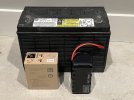
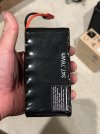
Here's a pic of a Cat Group 31 lead-acid battery with a military issue Brentronics BB-2590 lithium ion radio battery and a custom lithium ion battery pack I use in my prototypes. The BB-2590 is both 12v/24v while my custom li-ion is only 24v.

IMG_7382.JPGIMG_7383.JPG

The Cat 31 holds 100amps at 12v so 1,200 Watt-Hours (Wh) which means it more/less can provide 1,200 watts of continuous power for an hour before being completely dead. But remember that you can only discharge a typical lead acid battery to roughly 50% before it starts to sulphate (for a starting battery, not a deep cycle or AGM) so you only get ~600 Wh of usable capacity in a 55lb box with about 0.5 cubic foot (ft3) volume.

The BB-2590 is rated at 298 Wh, weighs 3.1lbs and is 0.03 ft3 in volume.

My custom li-ion pack has 348 Wh, weighs 3.2 lbs and occupies 0.024 ft3.

You can easily discharge a typical lithium battery down to 5% ( or 95% depth of discharge) so you're getting pretty much all the capacity it has to offer.

So when you compare equivalent available energy capacities in typical use, a flooded lead acid battery weighs 10x more and occupies 10x the space of an equivalent lithium battery.

But the truly amazing aspect of lithium ion batteries is you can adjust their chemistries to be either extremely energy dense (like my custom packs for 4 hours of discharge) or extremely fast discharge (like certain lithium polymer cells found in the jump packs we're discussing above). If my custom pack was built with those high-discharge cells, that small pack could dump all 348 Watt-hours of capacity in only a couple mins as opposed to over a full hour. That translates to 10,440 watts of continuous power draw for that little pack for two mins. Compare that to the Cat group 31 that is rated to dump a max of 750 amps (CCA) at ~12v or ~9,000 watts of power. Granted the Cat batt can do this for 4 mins instead of just two for the li-ion but it's still impressive the li-ion can out-sprint the Cat for even a couple mins.

So bottom line: a piddly lithium battery can produce more cranking power than a lead acid battery while still being only 10% the weight and size.

Hope folks find this informative.

 

Mr. Wrench

Senior Member
Joined
Oct 23, 2025
Messages
383
Location
Ohio
Occupation
Mechanic
To mockingly quote myself, I really am impressed with the amount of power a li-ion battery pack can produce and I wanted to explain it a bit more so folks here can make up their own mind about using them or not.

Here's a pic of a Cat Group 31 lead-acid battery with a military issue Brentronics BB-2590 lithium ion radio battery and a custom lithium ion battery pack I use in my prototypes. The BB-2590 is both 12v/24v while my custom li-ion is only 24v.

View attachment 359602View attachment 359603

The Cat 31 holds 100amps at 12v so 1,200 Watt-Hours (Wh) which means it more/less can provide 1,200 watts of continuous power for an hour before being completely dead. But remember that you can only discharge a typical lead acid battery to roughly 50% before it starts to sulphate (for a starting battery, not a deep cycle or AGM) so you only get ~600 Wh of usable capacity in a 55lb box with about 0.5 cubic foot (ft3) volume.

The BB-2590 is rated at 298 Wh, weighs 3.1lbs and is 0.03 ft3 in volume.

My custom li-ion pack has 348 Wh, weighs 3.2 lbs and occupies 0.024 ft3.

You can easily discharge a typical lithium battery down to 5% ( or 95% depth of discharge) so you're getting pretty much all the capacity it has to offer.

So when you compare equivalent available energy capacities in typical use, a flooded lead acid battery weighs 10x more and occupies 10x the space of an equivalent lithium battery.

But the truly amazing aspect of lithium ion batteries is you can adjust their chemistries to be either extremely energy dense (like my custom packs for 4 hours of discharge) or extremely fast discharge (like certain lithium polymer cells found in the jump packs we're discussing above). If my custom pack was built with those high-discharge cells, that small pack could dump all 348 Watt-hours of capacity in only a couple mins as opposed to over a full hour. That translates to 10,440 watts of continuous power draw for that little pack for two mins. Compare that to the Cat group 31 that is rated to dump a max of 750 amps (CCA) at ~12v or ~9,000 watts of power. Granted the Cat batt can do this for 4 mins instead of just two for the li-ion but it's still impressive the li-ion can out-sprint the Cat for even a couple mins.

So bottom line: a piddly lithium battery can produce more cranking power than a lead acid battery while still being only 10% the weight and size.

Hope folks find this informative.
That was a good post.

What do you use your battery packs for?
 

aighead

Senior Member
Joined
Apr 25, 2019
Messages
3,424
Location
Dayton, OH
I don't understand battery tech at all but is there a reason we don't use those instead of normal starting batteries? Can we charge them with an alternator like we do with our normal batteries? I understand the fire risk is greater but it seems like an interesting option.
 

LCA078

Senior Member
Joined
Sep 29, 2019
Messages
726
Location
Austin, TX
What do you use your battery packs for?
We build portable air cooling/ventilation systems the military. Think of a ruggedized, overbuilt fan that runs on batteries and is used to keep maintenance crews cools when working on hot equipment in hot environments.
 

LCA078

Senior Member
Joined
Sep 29, 2019
Messages
726
Location
Austin, TX
I don't understand battery tech at all but is there a reason we don't use those instead of normal starting batteries? Can we charge them with an alternator like we do with our normal batteries? I understand the fire risk is greater but it seems like an interesting option.
Lithium ion automotive batteries are readily available on the market but they are still expensive compared to lead acid batteries when used as a starting battery in automotive setups. A cheap (i.e. unreliable) lithium ion automotive battery is still 2-3x the price of a lead acid. The other reason is you don't see lithium ion used as a starting battery is lead acid can take a lot of abuse and operate over a much broader range of operating temperatures whereas lithium ions don't like to be situated in a hot engine bay before they begin to degrade. Even the Goodall jump pack operating manual says: "Operating Temperature. This product is designed to be stored in temperatures between 40° F and 75° F (4° C and 24°C). The unit can be operated in temperatures between -4° F and 140° F (-20° C and 60° C). Do not operate outside of this temperature range." So basically, you're keeping your jump pack in the garage and only taking it out of a protected environment when you need it.

But if you need a deep cycle battery that can produce lots of power compared to it weight and size, then yes, lithium ions are the right choice. That's why a lot of the serious RV/camper folks use lithium ion as they storage batteries when off the grid. Same reason why lithium ion made electric cars feasible. No way could an electric car built with lead acid batteries achieve the distance-to-weight ratios you find with today's EV's.

I personally don't think lithium batteries are the right solution for starting motors today. Maybe tomorrow with improved chemistries and technology, but for today, lead acid is much cheaper and more reliable over extreme temps.
 
Top