• Thank you for visiting HeavyEquipmentForums.com! Our objective is to provide industry professionals a place to gather to exchange questions, answers and ideas. We welcome you to register using the "Register" icon at the top of the page. We'd appreciate any help you can offer in spreading the word of our new site. The more members that join, the bigger resource for all to enjoy. Thank you!

Mini on steep slopes

db4570

Member
Joined
Sep 22, 2015
Messages
10
Location
Western New York
I have a decent amount of time on ag tractors, but excavators are a new thing for me.

I rented a Deere 35D and spent a couple of days clearing some of our land with it. Ripping out small trees and brush, moving boulders with the thumb, and making paths. I will need a bigger unit for the basement excavation, which I probably won't tackle myself. But I like this thing for these general chores, and am considering buying it.

The land is steep. Much of it is 25% or steeper slope. Obviously my biggest fear is rolling the thing. Crawling up a steep slope is a little nerve-racking, but I haven't had any white-knuckle experiences yet. The guy at the dealer said it will work on anything that I can walk up. My neighbor, who owns and operates all sorts of machines, says I have nothing to worry about.

It all seems very vague, for something so important. A couple of times it has gotten a bit wobbly, but I don't know how much is too much.

How do you KNOW when you're about to get into trouble before it's too late? Youtube has a couple of things with excavators on slopes, but mostly not very useful.

Also, when digging uphill, I assume I have the blade lowered behind me?

I appreciate any help and suggestions.
 

PeterG

Senior Member
Joined
Apr 14, 2015
Messages
785
Location
United States
Occupation
Contractor
have the blade lowered behind me?
Yes, have the blade on the downhill. When going up the hill you can have the blade behind you near the ground, and extend the stick and bucket out way up above the hill. Or you can go backwards using the arm over the blade and at times using the arm and bucket to push yourself backwards up the hill. Once up the hill, reach up the hill and dig out yourself a more level platform and place the machine on it. Then dig. Keep the bucket when full of dirt barely above the ground for more control when moving it.

The machine can still work for a basement dig and you can do it. It's of course faster and easier to have a full size machine to dig and reach out of the basement dig area. But the mistake most people make is on how much dirt comes out and what to do with it and how to move it. If you just pile it along the sides you still need to move it which can easily be a couple of hundred yards or more.

To dig with the smaller machine, Start in the far end and dig the outline down four feet deep and load into the dump truck. Once you're four feet deep dig a bit deeper and leave fill around the perimeter for back fill. Then do the next for feet deep leaving yourself a dirt ramp in one corner to get in an out. Slow, so a bigger machine for sure is always going to be better.

The expensive hard part is to get rid of the dirt. You may need a track loader. You may need a grading permit or some planning to dump 200 yards on the property. The amount of dirt could be 20 full size dump truck loads or more.
 

db4570

Member
Joined
Sep 22, 2015
Messages
10
Location
Western New York
Thanks for the reply. These are good suggestions.

Let's say I am carefully digging uphill. Is the risky part when I rotate to one side to dump? It seems like that's when the center of gravity would shift. What is the riskiest part about digging on a hill? Crawling? Digging uphill? Swinging to the side? What can really get one into trouble?

I wish there were clear warning signs.

I think I will go with the bigger one if I decide to try the basement excavation. There are a ton of boulders here. More rocks than dirt. Many basketball size, many Yeti cooler size, and a few refrigerator size ones. The fridge ones I may need to break up with a hammer. So far they break fairly easily. Some of the rocks I want to save, so the thumb would be very useful for that.
 

skyking1

Senior Member
Joined
Nov 3, 2020
Messages
9,612
Location
washington
you need to tune your butt dyno. Don't go up on the steep bank until you get a feel for what a full bucket does over the side vs over a corner, etc.
Do not expect the machine to act the same when you jack it up with the blade, vs having the whole track on the ground. It does not.
Avoid long reaches right over the side. Plan your work so you reach over a corner.
Swing with the load closer, then reach. Less drama.
There are clear warning signs, that is your tuned up butt Dyno.
You can make flat to sit on with a fill, but it is going to settle alarmingly when you work over the side on fill till it gets some compaction. Plan accordingly.
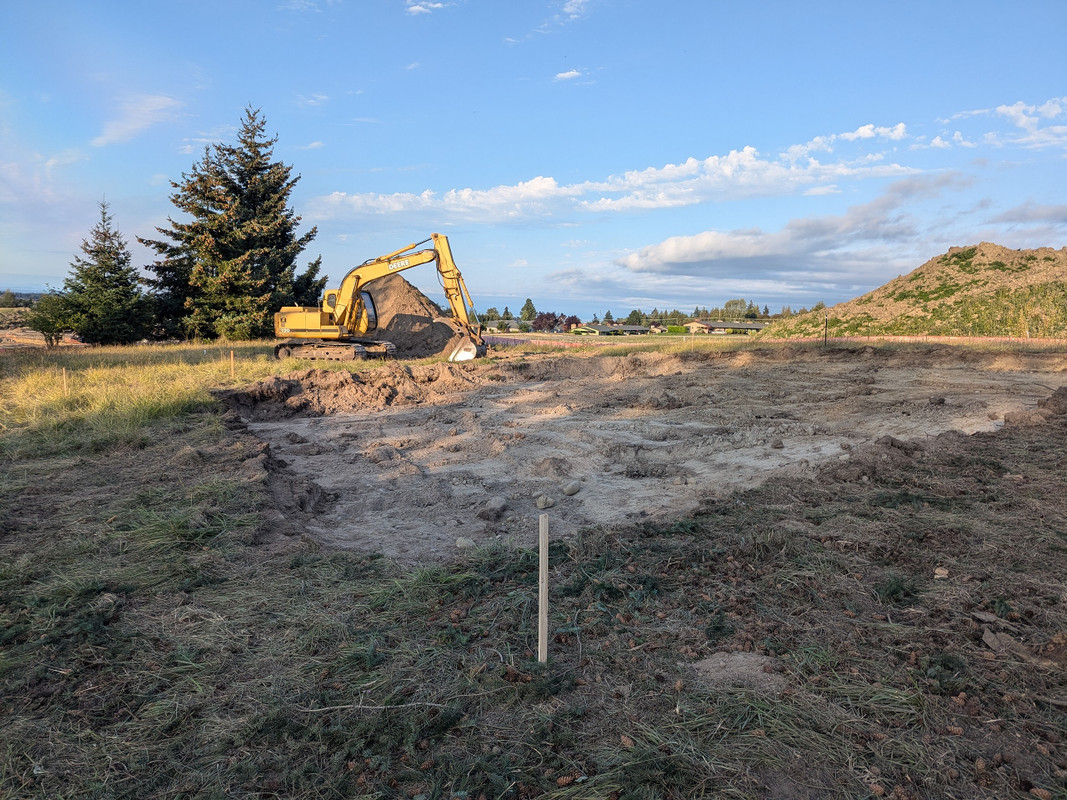
I was able to place all the spoils around my daylight basement dig and then some.
Stripped the topsoil.
PXL_20240903_013848528.jpg


Set up a rough grade and then got the magnetic target right.
After the millionth trip out of the seat to check grade, these things pay for themselves when working alone.
PXL_20240907_154213699.jpg


Rough dug it to + 2 tenths of a foot or so. This step may vary if you do not plan on a ramp down into the basement dig.
PXL_20240907_214456844.jpg


Put on a clean up bucket if you have one and slick it off to grade. Dig footings and plumbing etc.
PXL_20240909_003743765.jpg


cooler sized rocks embedded in natural fill is a terrible day(week!) on a small excavator.
Consider hiring the basement dig out to a company with a big machine.
Once those rocks are free of the earth, they are fun with a mini.
 

Nige

Senior Member
Joined
Jun 22, 2011
Messages
38,664
Location
G..G..G..Granville.........!! Fetch your cloth.
You can make flat to sit on with a fill, but it is going to settle alarmingly when you work over the side on fill till it gets some compaction. Plan accordingly.
I think this should generally be your aim when working on a slope. Try as best you can to dig a platform that you can then move onto where the machine will be level, or at least close to it.
 

skyking1

Senior Member
Joined
Nov 3, 2020
Messages
9,612
Location
washington
^sometimes a cut is possible, but other times you are working on or bringing a fill with you. You just need to have a plan to allow for the settling and room to move and regrade repeatedly as it gets firm enough.
Here is a situation like the OP's. My nephew has very little experience, but I was instructing him and tracked in the bench. Everything 4' above the bottom of the trench is a fill that has been moved here and there.
Do the long reaching over the corner.
PXL_20250702_231100900.jpg
Bring the load in close when directly over the side.

PXL_20250702_232915840-1.jpg
Don't swing full buckets till the conditions are confirmed. Us old guys have a finely tuned butt dyno so it looks easy. He was in the pucker zone for him. I figure the OP is feeling the same way.
 

PeterG

Senior Member
Joined
Apr 14, 2015
Messages
785
Location
United States
Occupation
Contractor
The Deere 35D is called a "zero" turn machine. The machine is designed to work in tight areas so that when you slew (Turn the cab), the back of the machine won't hit anything. The machine for it's size and weight may not be as stable as a conventional tail swing machine. This means that on lifting a bucket size load, the conventional swing machine has more counter weight in the back and may be less tippy and more powerful. It also means a conventional tail swing machine may not go up a hill as well with a lot of weight in the back especially with the blade in the back. This makes the rear of the tracks bite into the slope, but the front uphill tracks may not be getting much traction. To climb the hill you may need to reach far forward with the bucket stretched 17' forward (Deere 35D) up the hill. A bigger bucket especially with dirt in it will give you more traction and stability on the uphill side tracks. You can also use the bucket to dig it into the ground up the hill and then use the tracks and the arm/bucket to pull yourself up. To go back down the hill, keep the blade in front just above the ground, and use the arm and bucket over the blade out in front to stop you from sliding even digging the bucket and blade into the ground. Always be prepared to immediately lower the blade or the bucket.

When turning to the side of the machine, pay attention to bucket size and material weight. A 3-4' wide bucket full of wet clay is much heavier than a 2' wide bucket of dry dirt. It can be best to get your load and bring the bucket towards you close to ground (a foot or less above ground), and then turn if needed. At first use some of the dug up dirt to help make a better platform for the machine to sit on. Make sure the platform is not wet soft squishy stuff.

That being said, hill work is best not do until you have a few days on a excavator and know what all the controls do. Keep your seat belt on. Excavators do rock around a bit tipping and that is ok. Just always have in your mind that whatever you are lifting may fall out (causing the balance of the machine to shift or maybe the ground may shift), and that you may need to rapidly (like slamming on the brakes in a car) lower the arm/bucket or spill the load so that you don't keep tipping over. Study the lift chart of the machine and the manual, which can be often found online.
 

Nige

Senior Member
Joined
Jun 22, 2011
Messages
38,664
Location
G..G..G..Granville.........!! Fetch your cloth.
Study the lift chart of the machine and the manual, which can be often found online.
If the manual didn't come with the machine ask the rental company for a copy. I'm not 100% sure about the rules but in a rental machine isn't it mandatory for a copy of the operation manual to come with the machine.?
 

fast_st

Senior Member
Joined
Dec 1, 2010
Messages
1,619
Location
Mass
Occupation
IT systems admin
I was surprised how quickly a mini can fill a triaxle truck from a stockpile, slower than a big machine but not too slow. I had the driver on the headache rack pointing out holes that needed a few more scoops :) He was happy I didn't bang into his truck and didn't throw dirt all over his super clean rig.
 

BC Placer gold

Senior Member
Joined
Mar 6, 2014
Messages
1,174
Location
Enderby, Bc Canada
A lot of really good advice has been given!

A few thoughts....will say that my experience with a Deere 35D has shown it is a remarkably stable machine for its size. It does have decent undercarriage width/length for its size. We currently run a 50D (6', 7" width) and it also is very comfortable/capable on slopes.

If I have the space, my preference on a steep climb is to stretch out the boom/stick/bucket fully; keeping everything just above ground level (adjust as necessary to conform with topography). With this method you can climb up some very steep slopes or stockpiles (with a mini or a 210, same idea...) If the material is too loose then you may have to track up in reverse while helping with boom/stick...this takes some practice to do in a smooth manner without (excessive) lifting of carbody.

Then get the machine levelled in the manner that others have described. Once on a pad regardless of machine size I track back and forth several times (and even off track a bit, for width) this allows decent compaction of your working pad. The nature of our work often means a lot of deep digs/excavation of material from deep pits. My personal rule of thumb is NEVER any digging with tracks parallel to pit edge...common sense really.

Main thing; just take it easy as you gain experience. Also as has been mentioned; levelling the machine with just the blade can be risky and unstable as you swing....ie suddenly substantial tipping event could occur. Best done only during preparation of proper level working pad. And always keep load low and tucked in tight while swinging house; then extend....I suspect this technique also reduces loading on the swing bearing. Good luck--be safe!
 

fast_st

Senior Member
Joined
Dec 1, 2010
Messages
1,619
Location
Mass
Occupation
IT systems admin
Knowing your ground too, I have glacially compacted clay here, you can't scoop it with a regular size machine, you have to scrape it, its like soft concrete but it'll hold the world on the very edge of the trench. Bud was worried about collapse, I drove a 20 penny nail into the side of the trench all but 1/2 inch then hooked my heel on it and stood on the nail.
 

smifwal

Senior Member
Joined
Mar 6, 2024
Messages
443
Location
kansas city
I will add keep an eye on what your undercarriage is doing as you're digging. You run in to rocks or heavy dirt you may spin your undercarriage and get yourself in a real pickle.

I have a fair amount of time in a mini excavator and my butthole pucker still especially when she gets to teetering. Worse I have grade controls and I'll think yeah this is kind of steep and I'll look down and it will say and even more scary number than I thought it was1000044135.jpg
 

IceHole

Senior Member
Joined
Aug 14, 2023
Messages
1,442
Location
AK
I have a 2013 Hitachi ZX40 with steel tracks. Never came with a seat belt and no place to mount one without fabbing something which is very weird.

It's definitely nerve racking in that tiny canopy "cab" vs a real sized with a cab machine. Feels like trying to sit on a kid's go cart . I can't use the pedals to track, my feet arent small or bend enough.

Have lots of hours in a 200 and 330.
 

gwhammy

Senior Member
Joined
Nov 20, 2013
Messages
632
Location
missouri
May sound dumb but always have tracks running up and down the hill and don't raise your bucket very high going over the side and boom as low as you can. I've tipped many of them of all sizes but they will stop when the bucket hits the ground. Slid they down some probably 60 degree cuts. Once you've spent thousands of hours in equipment your butt will tell you when you are in trouble. Only machines I've turned over are skid steers several times back when I was younger. They always stop when they reach the bottom.
 

Allan M

Well-Known Member
Joined
Oct 20, 2020
Messages
165
Location
95037
Occupation
Semi-retired: Strategic planner/author
I have a decent amount of time on ag tractors, but excavators are a new thing for me.

I rented a Deere 35D and spent a couple of days clearing some of our land with it. Ripping out small trees and brush, moving boulders with the thumb, and making paths. I will need a bigger unit for the basement excavation, which I probably won't tackle myself. But I like this thing for these general chores, and am considering buying it.

The land is steep. Much of it is 25% or steeper slope. Obviously my biggest fear is rolling the thing. Crawling up a steep slope is a little nerve-racking, but I haven't had any white-knuckle experiences yet. The guy at the dealer said it will work on anything that I can walk up. My neighbor, who owns and operates all sorts of machines, says I have nothing to worry about.

It all seems very vague, for something so important. A couple of times it has gotten a bit wobbly, but I don't know how much is too much.

How do you KNOW when you're about to get into trouble before it's too late? Youtube has a couple of things with excavators on slopes, but mostly not very useful.

Also, when digging uphill, I assume I have the blade lowered behind me?

I appreciate any help and suggestions.
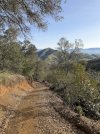
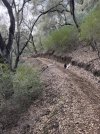
Hello db4570: I own 17 acres of property in Northern California. Most of the terrain is too steep to walk and too heavily forested to walk through even if you could navigate the steep terrain. 3.5 years ago I purchased a Kubota U55-4 excavator after renting it for two days to cut fire breaks near the house. Since then I have cut horse/ATV trails on the property from 740' elevation to the tip of my orange pen at 1370' (see photo). The top of the ridge is just over 1/4 mile away. Most of the hills are 40+ percent in steepness with many near 75%. Many areas I cut through are not walkable. Too steep; too wooded. So, as you can see from the attached photos I've learned to follow the contour of the hills to cut just over 1/2 mile of 8' foot wide ATV trails on the property. I've learned a great deal from the pros on this site. That said, unless I don't under what you're up to then I have a bit of a different take on how to use an excavator cutting trails on a hill. First, going directly up hill in steep terrain is not an option. It's too steep for the machine and certainly too steep to walk after the cut. My 12.4k lb machine is kinda' the right size for what I'm doing. Not too light and not too heavy so that I can use it elsewhere on the property for smaller tasks. I study the hill and choose a cutting path that avoids large trees (over 2' in diameter). I have 12 varieties of Oaks (these are tough!), manzanitas, and various brush. I start the machine on level ground then clear the top soil and vegetation first in front of me, dig on the downhill side to find the virgin soil and then work my way back up hill in order to make the notch. I'm using a 2' bucket (450 lbs) which is not tippy with my machine (as long as I keep the machine level). I'm always careful to keep my downhill track on virgin soil (working across the slope). To do this, sometimes I need to cut the uphill side down as much as 12' to 14' given the slope--which might exceed 60 degrees. That is, looking on the downhill side it's almost straight down. I always cut over the blade! Why? 1) stability--I have thousands of pounds of weight in front with the boom, arm, bucket and material, 2) I need the dozer to push the cuttings toward the downhill edge using my angle blade, 3) I need the blade for additional bracing if I'm taking out tough brush or trees. And as a note, gravity is a b***h. Don't tackle trees that are above you or that have the gravity and weight advantage. Several times I move the excavator back, hit the tree with my chain saw, and then finish it with the excavator. My machine has the power to cut through 4" to 6" oak tap roots. These are on 12" to 2' oaks that might be 30 to 50' in height. I won't tackle anything larger while cutting in the mountains. Also, make sure your initial cut is about 6"to 8" lower on the uphill side. That way you will be making a natural culvert for rain water. If you don't do this any major rain storm will certainly tear up your road surface. The excavator is also a great compactor. So, back dragging multiple times with the blade as you progress helps compact the cut and clean up the road surface. I also have a tractor with a box scraper I use to groom my roads over time. It's been an interesting learning experience. As noted above, always wear your seatbelt! If something does go wrong staying inside the machine is your best chance. If dialog on this would be helpful I'm happy to share all of my mistakes I've made too. Best in your adventure. A
Pic1.jpegPic3.jpegPic5.jpegPic4.jpeg
 

PeterG

Senior Member
Joined
Apr 14, 2015
Messages
785
Location
United States
Occupation
Contractor
I have cut horse/ATV

Allan M, very nice work on your trail/road building! Regarding the original question of the post about getting the mini excavator up a hill and digging, we don't know if he is building access, retainer walls, erosion control, clearing out an area, drainage, or just trying to learn how to get out of the hole they just dug or basic climbing skills. So this is just some basic important skills to learn and remember.
 

BC Placer gold

Senior Member
Joined
Mar 6, 2014
Messages
1,174
Location
Enderby, Bc Canada
Nice work Allan M!

You have taken a good approach to learning trail building in steep country. Keep road bed on cut---not fill--- yes indeed! critical for safety.

I agree that size machine is very capable; also significant stability benefits due to increased width (~1' wider than a Deere 35D).
 
Top