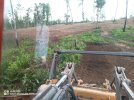
After finishing the installation of the new teeth, I fired up the drum rotation. This Seppi unit holds balance better than any of my other cutterheads. I am impressed! It was good enough to start operations immediately, had it not been so wet. I had enough dry time according to radar so I set about to trim up the balance to make it better. I think that I only added about 60 grams of weight per side via a few welding rods. It's not perfect but it is smooth and better. The only way to get it 100% would be to bring in my "lock gate" structure to bind the head down to. It's a former lock gate from the Smithland Locks on the Ohio River according to the seller that I got it from. By binding the cutterhead down to a large, massive object, harmonic oscillations are minimized and balancing results are more precise for the fastest and best results. I did not need to haul 4k-5k lbs of wooded structure up those steep, muddy hills for extra precision. Sometimes good in the field is good enough until I get it back to the shop if I want it closer to perfect.
For those without the experience, balancing is as much an art as it is frustration in motion. The results are great but the road getting there is usually agravating and time consuming. I dread doing it but it is required if you want your bearings and equipment to last.
Hard to believe a rod or two can make a huge difference in balancing a 6k-7k lb rotating mass!

I should have recorded the original vibrations at full speed but I did not. At near 1/2 full speed, this was the result before balancing commenced.

After a few iterations and having enough of this, here are the results at full speed. Several thousand lbs rotating at 1,686 rpms with over 300 hp being sent down line. Who do you think wins when contact is made with other objects? Definitely not the furry or scaly little critters too slow to get out of the way!

I meant to take a pic of the balancer hook up but I forgot to. It consists of a magnetic mounted LED light sensor that reflect off of a piece of reflective tape mounted to the rotating mass's flywheel and two magnetically mounted vibration sensors mounted above the rotating shaft on either side of the head. This allows 2 plane balancing which is critical for longer shafts. Only short shafts can be properly balanced with single plane (1 sensor) balancing. I used to always use the laptop with an Excell spreadsheet program to calculate the results (lots of vector math via matrix equations) until I found a free app for the Android phone that works just as well. Now balancing in the field is much easier and more convenient. And I don't have to fight to read the laptop or keep it in the dry. No idea how much a new balancer cost today - this one was $5,500 back in the late '90s.



 I do this because I enjoy it and it provides me more sanity than sitting behind a desk using my other skills.