• Thank you for visiting HeavyEquipmentForums.com! Our objective is to provide industry professionals a place to gather to exchange questions, answers and ideas. We welcome you to register using the "Register" icon at the top of the page. We'd appreciate any help you can offer in spreading the word of our new site. The more members that join, the bigger resource for all to enjoy. Thank you!

Cat 120H Transmission

Joined
Aug 20, 2020
Messages
10
Location
Uruguay
I’m working on a 120H, serial number P5FM04921.


Initially, the motor grader had no power in reverse. It also had another issue: when engaging reverse in any gear and pressing the clutch, the machine would move forward.


We decided to disassemble the transmission and found that the last reverse clutch disc (Clutch 3) was out of the splines, slightly bent and worn. The piston was also quite worn. We decided to replace all the discs in that clutch pack and the piston.


After reassembly, reverse regained power, but the issue persisted — pressing the clutch while in reverse still caused the grader to move forward.


We ran some tests, and after a while, forward gears 2, 3, and 6 stopped working. We disassembled the transmission again and this time found the same issue, but in Clutch 2.

We performed the following tests:


  • Swapped solenoid valve 2 with valve 4, and valve 3 with valve 4 — no change.
  • Disconnected the solenoid valve for Clutch 3 (A). In reverse, pressing the clutch no longer made the machine move forward, which led me to suspect a possible leak from that valve to Clutch 2.
  • While in reverse and experiencing the issue (moving forward when pressing the clutch), I measured pressures on Clutches 1 and 2, but did not detect any pressure.
  • Also, I have tested the electrical signals and they are OK.
Any ideas on what could be causing this?
 

Legdoc

Senior Member
Joined
Oct 6, 2007
Messages
731
Location
south texas
While I can't help you I feel your pain. I'm 99% sure I will be pulling the tranny on my 120H and do a
'forensic" level inspection and rebuild by the book. I only want to do this once. I suspect some forum experts and Cat master will be able to help. They sure kept me on track and I'm much appreciative of their expertise.
 

Nige

Senior Member
Joined
Jun 22, 2011
Messages
38,712
Location
G..G..G..Granville.........!! Fetch your cloth.
nitially, the motor grader had no power in reverse. It also had another issue: when engaging reverse in any gear and pressing the clutch, the machine would move forward.


We decided to disassemble the transmission and found that the last reverse clutch disc (Clutch 3) was out of the splines, slightly bent and worn. The piston was also quite worn. We decided to replace all the discs in that clutch pack and the piston.


After reassembly, reverse regained power, but the issue persisted — pressing the clutch while in reverse still caused the grader to move forward.
That suggests to me a couple of possibilities.

1. That the something is binding in #3 (reverse) clutch causing it not to completely release. Maybe the piston is/was not retracting correctly.? You mention that the piston was "quite worn". What was the condition of the housing in which the piston slides.?
2. The possibility that another clutch is stuck in the engaged state even though no pressure is being applied behind the piston.

Based on the fact that you have already done two transmission disassemblies and each time found a clutch in bad condition IMHO it is time to pull the transmission for a thrid time but this time go through every one of the 8 clutches and compare the state of the friction discs & separator plates with the specification.

Another comment. By simply replacing friction discs in Clutches 2 & 3 you could be missing a trick because the steel separator plates do wear. They also tend to warp, especially if the clutch has been slipping as a result of worn friction discs.

It is also a possibility that there is a crack between two clutch supply ports in the control valve body. You will only find that by a complete disassembly of the control valve. Here is a comment from another thread - "For what it's worth, I went through my records & the clutch that was affected on the 140H with the cracked control valve housing was No.7 and one other. I think I was getting some pressure in a clutch that shouldn't have had any during some gears due to leakage between the internal ports because of the cracked web. That machine had burnt oil & a slight amount of clutch material in screens."

Also attached a Service Magazine on the subject of the control valve body cracking.
 

Attachments

  • SEPD1551-00 - Improved Trans Ctrl Vlv Body.pdf
    197.4 KB · Views: 9
  • SENR9157-04 - Transmission Specs.pdf
    114.8 KB · Views: 6
Joined
Aug 20, 2020
Messages
10
Location
Uruguay
First of all, thank you very much for paying attention to my case and helping me in the search for a solution.


I’d like to clarify that I haven’t finished assembling the transmission for the second time yet, so I still have the opportunity to check anything necessary.


Let me share some other tests and measurements I carried out:


  • In both teardowns of the transmission, I measured all the discs and plates. All of them were within CAT specifications, except for the discs from the affected clutches: Clutch 3 in the first teardown, and Clutch 2 in the second teardown. All discs and plates from the affected packs were replaced, including the piston.
  • I think it’s important to highlight the symptom and the test performed after the first reassembly:
    • When engaging any reverse gear and pressing the clutch, the machine moved forward.
    • There was no pressure detected in any clutch pack that shouldn’t have pressure.
    • When releasing the clutch, the grader moved backward, but with a clear overload on the engine.
    • In forward gears, everything worked fine — meaning the machine did not move forward when pressing the clutch.

This led me to think it could not be a mechanical blockage, since the issue was only present when Clutch 3 was active. I even disconnected the solenoid for Clutch 3 and tried reverse: the result was that the grader did not move forward when pressing the clutch, but it also did not move backward.


I have considered a possible leak inside the control valve body, and I imagine if that were the case, it would have to be between the pressure outlet from the solenoid of Clutch 3 and Clutch 2. What confuses me, however, is that I haven’t recorded any incorrect pressure readings (pressure showing up in the wrong clutch during a gear). This is the part that leaves me the most puzzled.
 

Nige

Senior Member
Joined
Jun 22, 2011
Messages
38,712
Location
G..G..G..Granville.........!! Fetch your cloth.
After reading the above my first question is whether or not this issue has developed during the time you have been associated with the machine or did the machine come to you from somewhere else with the problem already existing.? If it is the latter then the next question is do you know whether or not the transmission was ever removed and disassembled before you removed it the first time.?

I think it’s important to highlight the symptom and the test performed after the first reassembly:
  • When engaging any reverse gear and pressing the clutch, the machine moved forward.
  • There was no pressure detected in any clutch pack that shouldn’t have pressure.
  • When releasing the clutch, the grader moved backward, but with a clear overload on the engine.
  • In forward gears, everything worked fine — meaning the machine did not move forward when pressing the clutch.
This is the most important information.

"Engage reverse and EVEN with the modulation pedal depressed, which should inhibit all transmission functions by dumping directional clutch pressure, the machine moves forward". This in itself proves that there is something mechanical, not necessarily as a result of commanded pressure in the transmission control valve, that is causing a clutch to engage.

The important thing to remember is that to select any transmission speed in forward or reverse requires three clutches to be engaged. You also have to bear in mind that two clutches (#5 and #8) are engaged even when the transnmission is in neutral. So it only requires one clutch to be playing up mechanically for drive to occur.

Personally my suspicion falls on the shaft that contains the #7 (Fwd Low) and #8 (Fwd High) clutches. It is a known problem area and especially certain parts of Clutch #7 are easy to assemble incorrectly. This brings me back to my earlier question regarding whether the issue developed before or during the time you have been associated with this machine.?
 
Joined
Aug 20, 2020
Messages
10
Location
Uruguay
The machine was already showing the symptom before the first teardown, which was actually the very first time the transmission had ever been opened. I believe this symptom is what caused the damage first in Clutch 3 and later in Clutch 2.


I understand the concept of three clutches being applied to achieve one gear. However, isn’t it necessary that at least one of the directional clutches — Clutch 1, Clutch 2, or Clutch 3 (the ones where pressure is modulated) — must always be active? My reasoning is that if there were a mechanical blockage, the machine should also move with the clutch pedal pressed in other gears, even in neutral.


I think this point is very important. While the symptom was occurring, I disconnected the solenoid for Clutch 3, and the machine stopped moving forward when pressing the pedal. Of course, when releasing the pedal, it also didn’t move backward.
 

Nige

Senior Member
Joined
Jun 22, 2011
Messages
38,712
Location
G..G..G..Granville.........!! Fetch your cloth.
However, isn’t it necessary that at least one of the directional clutches — Clutch 1, Clutch 2, or Clutch 3
I need to clarify something. The directional clutches are #3 (Rev), #7 (Fwd Low), and #8 (Fwd High).
I was assuming that you were referring to the same clutch numbering system that I understand. Now I am not so sure.

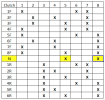
Please check Page 2 of the attachment. I have marked all the clutches as per the system the factory uses. Can you please confirm which clutches failed on your transmission. Was it actually #2 and #3 clutches per that document that you repaired or was it something else.?

1755517664534.png
 

Attachments

  • SENR8503-04.pdf
    207.2 KB · Views: 7
Joined
Aug 20, 2020
Messages
10
Location
Uruguay
Sorry for the delay in replying, but I needed to review the documentation.


In the documentation I have, the so-called “directional clutches,” which are modulated by the clutch pressure, are Clutches 1, 2, and 3. The table you shared matches the one in my documentation.


In my documents, Clutches 4, 5, 6, 7, and 8 are referred to as “speed clutches,” and their pressure is not modulated by the clutch pedal.


Also, in the past few days I completely disassembled the transmission valve body and did not find any cracks.
 

Nige

Senior Member
Joined
Jun 22, 2011
Messages
38,712
Location
G..G..G..Granville.........!! Fetch your cloth.
In the documentation I have, the so-called “directional clutches,” which are modulated by the clutch pressure, are Clutches 1, 2, and 3.
That is correct. The engagement of the three directional clutches can be modulated by what Caterpillar refers to as the Inching Pedal.
Are you using an official Caterpillar Service Manual.?
If you are then do you have a publication reference for it. It will be something like RENRxxxx or SENRxxxx..?

The table you shared matches the one in my documentation.
I'm sorry but that is not correct. In the table I attached to Post #7 above the Reverse clutch is #3, the Forward Low clutch is #7 and the Forward High Clutch is #8.

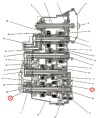
So comparing the nomenclature I use with the manual you are using then your "#2 clutch and #3 clutch" are what I would call the Forward Low and Forward High clutches. Can you confirm that the two clutches which failed in your transmission are marked #19 and #24 on the illustration below please.?

1756066343721.png
 
Joined
Aug 20, 2020
Messages
10
Location
Uruguay
Quizás me pueda equivocar, pero la información que tengo indica que los embragues direccionales son el 1, 2 y 3. Los embragues con los que he tenido problemas son el 2 y el 3.

También he verificado en la práctica que los embragues con presión modulada son el 1, 2 y 3, que corresponden a los solenoides B, C y A. Adjunto la publicación en la que baso esta afirmación, así como un boletín de servicio que describe exactamente lo que observé en el Embrague 3 durante el primer desmontaje y en el Embrague 2 durante el segundo.

También olvidé mencionar que según el diagrama, aquellos con los que he tenido problemas están marcados como #11 y #14.
 

Attachments

  • 120h Transmision control valve.pdf
    1.1 MB · Views: 3
  • BT Se sale el ultimo disco.pdf
    594.6 KB · Views: 2

Nige

Senior Member
Joined
Jun 22, 2011
Messages
38,712
Location
G..G..G..Granville.........!! Fetch your cloth.
OK, I can see where the misunderstanding has come about.

Clutches 1 & 2 are referred to as Forward High and Forward Low.
Clutches 7 & 8 are referred to as Low Range and High Range.

I think we are on the same page now. My apologies.

So the two clutches that burned out on your transmission were:-
1. Clutch 2 which is Forward Low and is used for speeds 2, 3, & 6 forward.
2. Clutch 3 which is used for all Reverse speeds.
 
Joined
Aug 20, 2020
Messages
10
Location
Uruguay
Exactly — and only the last disc in the clutch was damaged. It slipped out and blocked the piston from compressing the rest of the pack. All the other discs in that clutch were in perfect condition.
 

Nige

Senior Member
Joined
Jun 22, 2011
Messages
38,712
Location
G..G..G..Granville.........!! Fetch your cloth.
In all the repairs you performed did you disassemble any of the other clutches in the transmission apart from 2 & 3.?

I am wondering if another clutch has a mechanical problem that is causing it to not fully release when no oil pressure is being supplied to it from the transmission control valve. That is one possibility.

Another possibility is a leaking rotating seal that results in (maybe partial) pressure being sent from the control valve to a clutch that should not be engaged when a particular transmission speed is selected.
 

Nige

Senior Member
Joined
Jun 22, 2011
Messages
38,712
Location
G..G..G..Granville.........!! Fetch your cloth.
Having looked at the subject a little more my suspicions would rest on one or other of the two clutches that share shafts with the failed clutches #2 & #3.

My primary suspect would be #1 which is the Forward High clutch that is engaged in forward transmission speeds 1, 4, 5, 7, & 8.
The other one is #4 which is the Second Gear clutch (engaged in transmission speeds 2, 6, & 7 forward plus 2 & 5 reverse).

Of the two possible options I suspect Clutch #1.
 
Joined
Aug 20, 2020
Messages
10
Location
Uruguay
On both occasions I completely disassembled the transmission, checking all the clutches, their friction discs, and plates, without finding any defects other than the ones in the affected clutch.

I don’t believe this is caused by a stuck clutch. Let me repeat the test I performed:

The machine works fine in all forward gears and in neutral, with no noticeable anomalies. In reverse (any of the 6 reverse gears), when pressing the clutch pedal the machine starts moving forward. When releasing the pedal, the machine goes into reverse but clearly under load on the engine.

When checking pressures, values were only present in the correct clutches, without detecting even the slightest pressure in any other clutch. I disconnected solenoid A while the machine was in reverse and with the clutch pedal pressed (the wheels were turning forward). At the moment I disconnected the solenoid, the forward movement stopped. Of course, when releasing the pedal it also didn’t go into reverse.

My conclusion is that there must be an internal leak in the pressure controlled by solenoid A, which goes directly to Clutch 2. What seems odd is that this leakage cannot be measured at the test ports.

After several tests like this, Clutch 2 eventually stopped working (losing 2F, 3F, and 6F). Upon disassembly, I found that the last disc had slipped out of the pack, preventing the piston from compressing the clutch.
 

Nige

Senior Member
Joined
Jun 22, 2011
Messages
38,712
Location
G..G..G..Granville.........!! Fetch your cloth.
On both occasions I completely disassembled the transmission, checking all the clutches, their friction discs, and plates, without finding any defects other than the ones in the affected clutch.
Did you inspect the condition of the rotating seals on which the clutches run.?

My conclusion is that there must be an internal leak in the pressure controlled by solenoid A, which goes directly to Clutch 2. What seems odd is that this leakage cannot be measured at the test ports.
If you cannot measure it at any of the test ports then I would say it is not happening. All I can suggest is that you need to use a pressure gauge that has a maximum scale of no more than 50psi if you want to accurately measure any leakage that might be taking place. A 500psi gauge is not going to measure something like 20psi with any degree of accuracy.
 
Top