• Thank you for visiting HeavyEquipmentForums.com! Our objective is to provide industry professionals a place to gather to exchange questions, answers and ideas. We welcome you to register using the "Register" icon at the top of the page. We'd appreciate any help you can offer in spreading the word of our new site. The more members that join, the bigger resource for all to enjoy. Thank you!

Mini on steep slopes

Allan M

Well-Known Member
Joined
Oct 20, 2020
Messages
165
Location
95037
Occupation
Semi-retired: Strategic planner/author
Nice work Allan M!

You have taken a good approach to learning trail building in steep country. Keep road bed on cut---not fill--- yes indeed! critical for safety.

I agree that size machine is very capable; also significant stability benefits due to increased width (~1' wider than a Deere 35D).
I also found that the 3' bucket (540 lbs) is a bit too heavy to use on a steep hill. Makes my machine tippy. As long as I keep my tracks level relative to the cut on the hill using the 2' bucket isn't an issue when cutting and dumping tailings on the downhill side. My teachers were not the Kubota manual...it was the guys on this site over the years as I've invested about 1200 hrs on this project. I'm almost at the top of the ridge...another 60' in elevation to go and about 200'. Unfortunately, we've had a lot of rain lately. I've been cutting in flour soil and it is now a mucky mess. I'm likely a couple of months away from getting back up there.
 

Allan M

Well-Known Member
Joined
Oct 20, 2020
Messages
165
Location
95037
Occupation
Semi-retired: Strategic planner/author
I will add keep an eye on what your undercarriage is doing as you're digging. You run in to rocks or heavy dirt you may spin your undercarriage and get yourself in a real pickle.

I have a fair amount of time in a mini excavator and my butthole pucker still especially when she gets to teetering. Worse I have grade controls and I'll think yeah this is kind of steep and I'll look down and it will say and even more scary number than I thought it wasView attachment 356670
Hi Swifmal: What kind of machine has this sophisticated Pitch/Roll screen/monitor? Or is this an aftermarket gadget? I think it's terrific. A
 

reganj

Senior Member
Joined
Jan 1, 2024
Messages
352
Location
Central Ms
If you want to be a cheap bassard like me, go to Harbor Freight and buy 02 Dial gauge angle finders with magnetic base for 4.99 each. They are analog and give you an approximation of your angle.
 

smifwal

Senior Member
Joined
Mar 6, 2024
Messages
443
Location
kansas city
Hi Swifmal: What kind of machine has this sophisticated Pitch/Roll screen/monitor? Or is this an aftermarket gadget? I think it's terrific. A
It is aftermarket, Trimble earthworks 2D with laser catcher. It was a game changer in the production sense not having to get out to measure depth, nor having to have a guy in the ditch with the grade rod, never over digging, and when I set transformer pads I can cut them level no matter what the ground around it is, I can use the blade to raise me up to level. So less gravel. And it never calls in sick or wants to take lunch. Worth every penny in my opinion.$17K there is a cheaper version called earthworks Go that uses your phone or tablet but you can't expand on that system, like adding a laser catcher or going GPS or UTS.
 

Allan M

Well-Known Member
Joined
Oct 20, 2020
Messages
165
Location
95037
Occupation
Semi-retired: Strategic planner/author
It is aftermarket, Trimble earthworks 2D with laser catcher. It was a game changer in the production sense not having to get out to measure depth, nor having to have a guy in the ditch with the grade rod, never over digging, and when I set transformer pads I can cut them level no matter what the ground around it is, I can use the blade to raise me up to level. So less gravel. And it never calls in sick or wants to take lunch. Worth every penny in my opinion.$17K there is a cheaper version called earthworks Go that uses your phone or tablet but you can't expand on that system, like adding a laser catcher or going GPS or UTS.
It amazes me how sophisticated the technology has become. You're working on a PhD level with your equipment. I'm grade school. Thanks for the explanation. Very cool. Just as a note, I don't think people that have never operated an excavator realize the power of hydraulics. It's amazing what you can do with these machines. I'd like to try a big boy machine at some point...maybe something like a CAT 320. Thanks again. The Trimble unit is a bit outside my budget!
 

db4570

Member
Joined
Sep 22, 2015
Messages
10
Location
Western New York
Good information, guys.

I threw a track off the machine but my neighbor (who happens to be a Deere mechanic) was able to help me get it back on. I am thinking I need something with more power and weight for what I want to do. Mostly a thumb to move boulders around, and dig footings. I am looking to rent a Cat 310 next.

I got the excavator bug, and really enjoyed my time with the Deere 35. I really appreciate what can be done with these things.

I need to dig a sewer trench down the steep (20-25%) part of the hill. So I need to dig up as I go.
The nature of what I'm doing for this doesn't really lend itself to digging a flat work pad every so often.

The next task is to remove the larger boulders from the future basement area. This I can do from a more flat position. Then I want to start excavating out for the footings, and see how far I can get digging out the basement before I hit a solid rock ledge. These I should be able to do from a flat pad I will prepare.

It sounds like, in general, if I am digging uphill, and keep the bucket weight uphill with minimal swinging, I should be OK. It's just tough to judge by feel when I am approaching the point of no return.
 

fast_st

Senior Member
Joined
Dec 1, 2010
Messages
1,619
Location
Mass
Occupation
IT systems admin
If you want to be a cheap bassard like me, go to Harbor Freight and buy 02 Dial gauge angle finders with magnetic base for 4.99 each. They are analog and give you an approximation of your angle.
On my tractor, yanmar excavator and the wheel loader I have a milwaukee magnetic level 48-22-5603 It doesn't give you lots of degrees, 1% 2% pitch but its a good eyeball and cheaper than the Grade 8 ball or whatever that thing was, hot item a few years back. Johnnyball? outside of my budget
 
Last edited:

skyking1

Senior Member
Joined
Nov 3, 2020
Messages
9,612
Location
washington
Hello db4570: I own 17 acres of property in Northern California. Most of the terrain is too steep to walk and too heavily forested to walk through even if you could navigate the steep terrain. 3.5 years ago I purchased a Kubota U55-4 excavator after renting it for two days to cut fire breaks near the house. Since then I have cut horse/ATV trails on the property from 740' elevation to the tip of my orange pen at 1370' (see photo). The top of the ridge is just over 1/4 mile away. Most of the hills are 40+ percent in steepness with many near 75%. Many areas I cut through are not walkable. Too steep; too wooded. So, as you can see from the attached photos I've learned to follow the contour of the hills to cut just over 1/2 mile of 8' foot wide ATV trails on the property. I've learned a great deal from the pros on this site. That said, unless I don't under what you're up to then I have a bit of a different take on how to use an excavator cutting trails on a hill. First, going directly up hill in steep terrain is not an option. It's too steep for the machine and certainly too steep to walk after the cut. My 12.4k lb machine is kinda' the right size for what I'm doing. Not too light and not too heavy so that I can use it elsewhere on the property for smaller tasks. I study the hill and choose a cutting path that avoids large trees (over 2' in diameter). I have 12 varieties of Oaks (these are tough!), manzanitas, and various brush. I start the machine on level ground then clear the top soil and vegetation first in front of me, dig on the downhill side to find the virgin soil and then work my way back up hill in order to make the notch. I'm using a 2' bucket (450 lbs) which is not tippy with my machine (as long as I keep the machine level). I'm always careful to keep my downhill track on virgin soil (working across the slope). To do this, sometimes I need to cut the uphill side down as much as 12' to 14' given the slope--which might exceed 60 degrees. That is, looking on the downhill side it's almost straight down. I always cut over the blade! Why? 1) stability--I have thousands of pounds of weight in front with the boom, arm, bucket and material, 2) I need the dozer to push the cuttings toward the downhill edge using my angle blade, 3) I need the blade for additional bracing if I'm taking out tough brush or trees. And as a note, gravity is a b***h. Don't tackle trees that are above you or that have the gravity and weight advantage. Several times I move the excavator back, hit the tree with my chain saw, and then finish it with the excavator. My machine has the power to cut through 4" to 6" oak tap roots. These are on 12" to 2' oaks that might be 30 to 50' in height. I won't tackle anything larger while cutting in the mountains. Also, make sure your initial cut is about 6"to 8" lower on the uphill side. That way you will be making a natural culvert for rain water. If you don't do this any major rain storm will certainly tear up your road surface. The excavator is also a great compactor. So, back dragging multiple times with the blade as you progress helps compact the cut and clean up the road surface. I also have a tractor with a box scraper I use to groom my roads over time. It's been an interesting learning experience. As noted above, always wear your seatbelt! If something does go wrong staying inside the machine is your best chance. If dialog on this would be helpful I'm happy to share all of my mistakes I've made too. Best in your adventure. A
View attachment 356778View attachment 356780View attachment 356782View attachment 356781

I remember we spoke at length about your projects when you were getting started. Thanks for posting pictures Allan.
 

smifwal

Senior Member
Joined
Mar 6, 2024
Messages
443
Location
kansas city
It amazes me how sophisticated the technology has become. You're working on a PhD level with your equipment. I'm grade school. The Trimble unit is a bit outside my budget!
I didn't start there obviously, I have had the level in the cab, the paint mark on the side of the bucket, had one of THESE for a while, this was the natural next step for me. I work by myself most days and it saves me a bunch of time, it makes me more accurate with less thinking, so I can think of what's next or make phone calls to line up more work, or just simply listen to a book while I am working.
 

PeterG

Senior Member
Joined
Apr 14, 2015
Messages
783
Location
United States
Occupation
Contractor
I am thinking I need something with more power and weight
I need to dig a sewer trench down the steep (20-25%) part of the hill

The Cat 310 is a nice machine and much better than the smaller 35D. However, I don't think getting it for weight and power is correct. The first step is to consider how deep is your septic line trench? The second best question is how much reach is a benefit. That is followed up by how much money do you want to spend on the rental (Weekly rate, delivery and pick up, fuel, etc). If the trench line is less than 6' deep and more like 3', then the smaller mini may still work. The larger machine does have an advantage with a larger bucket and thumb to pick up large rocks. Are you digging up and picking up 3000 lb rocks? I dig up rocks all the time and remove two man size rocks ( rocks about 4' long, 2' deep, and 2'tall) just fine with a 4.5 ton machine. It's easier with my 6 ton machine but that's with the bucket and thumb bigger, but not due to the power and weight necessarily. To dig the trench with the smaller machine, and even with the 310 you can climb up the hill (as described previously), set the blade, and dig going down the hill. You can also dig multiple platforms straddling the trench, move the tracks sideways across the trench and then dig sideways on both sides as much as you can. Are you using a 12" wide bucket? If you need to get into the trench and it's deeper than 4', you need trenching sides. Keep the dirt back from the trench at least one foot.
 

db4570

Member
Joined
Sep 22, 2015
Messages
10
Location
Western New York
The main reason I think I need more weight and power is for the larger boulders. The more we dig on the property, the more rocky it becomes. At first it seemed like it was more boulders than dirt. Now it seems like 80/20 boulders/dirt.

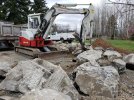
The attached picture is my (other) neighbor with his gigantic Deere 710 backhoe. All these rocks are a bit overwhelming. Some of them we want to save. So this is why I think a very strong thumb would be really useful here; to pluck them out, and sort them. The little 35D just didn't have the oomph.
 

Attachments

  • IMG_3774 c.jpg
    IMG_3774 c.jpg
    977.9 KB · Views: 22

PeterG

Senior Member
Joined
Apr 14, 2015
Messages
783
Location
United States
Occupation
Contractor
Those rocks don't look to bad. Remember to dig around a bit and then curl the bucket under the rock to loosen them. Best not to just reach out and just yank them out. I do rockery work for a living. See my picture below of my 6 ton machine.
 

Attachments

  • Two man size rocks.jpg
    Two man size rocks.jpg
    399.5 KB · Views: 21

PeterG

Senior Member
Joined
Apr 14, 2015
Messages
783
Location
United States
Occupation
Contractor
I think a 12" digging bucket will help to dig a bit in between and around the rocks and get in between better. Also a ripper tooth. It always amazes me that if the ground is full of thick stumps or large rocks, the machine can barely do any think. May be time to go full size big, like a 20 ton plus size machine or bigger.
 

Allan M

Well-Known Member
Joined
Oct 20, 2020
Messages
165
Location
95037
Occupation
Semi-retired: Strategic planner/author
I remember we spoke at length about your projects when you were getting started. Thanks for posting pictures Allan.
Your coaching (many sessions) is one of the reasons I'm still alive and haven't destroyed my machine. Thanks again!
 

skyking1

Senior Member
Joined
Nov 3, 2020
Messages
9,612
Location
washington
I think a 12" digging bucket will help to dig a bit in between and around the rocks and get in between better. Also a ripper tooth. It always amazes me that if the ground is full of thick stumps or large rocks, the machine can barely do any think. May be time to go full size big, like a 20 ton plus size machine or bigger.
there is no comparing loose rock dumped out of a truck for wall building, and an embedded small rock that got laid down and packed in 14000 years ago by the glaciers.
I had one layer of rock at my place that were loafs about the size of wheelbarrows, no bigger.
Same shape and size, and the glacier had laid them in like a Roman road. I had 120 rental and played hell trying to get started into them. The little rocks and thousands of years really cemented them in good!
 

smifwal

Senior Member
Joined
Mar 6, 2024
Messages
443
Location
kansas city
there is no comparing loose rock dumped out of a truck for wall building, and an embedded small rock that got laid down and packed in 14000 years ago by the glaciers.
I had one layer of rock at my place that were loafs about the size of wheelbarrows, no bigger.
Same shape and size, and the glacier had laid them in like a Roman road. I had 120 rental and played hell trying to get started into them. The little rocks and thousands of years really cemented them in good
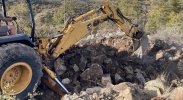
Had both senerios last week. Rocks moved around and put back when they did the sewer on one job and then side of the highway type of wall on the other. I had pot holes the 2nd job before giving them a bid and it was like shelf's but apparently I didn't spend enough time out there cause man we had a hammer on a skid and one on a mini and a 2nd mini pulling stuff out. All these are early in the dig , I was so mad by then end I didn't take any more pictures lol1000045256.jpg1000045254.jpg1000045886.jpg1000045885.jpg
 

skyking1

Senior Member
Joined
Nov 3, 2020
Messages
9,612
Location
washington
Yeah, that's slow going.
I did a job out at Rocky point. If that's not a hint. We were putting an 8-in ductile water down the road where it got down to one lane and there was a gas main on one side of us. The old water main we had about 18 in to chisel out solid Rock. We got about two sticks a day. That was miserable.
We had to keep that single Lane road open for the people who lived out there so there was a lot of movement but not a lot of action.
 

smifwal

Senior Member
Joined
Mar 6, 2024
Messages
443
Location
kansas city
This section was from secotionalizer to transformer about 80' took 8 hours. The client after seeing all of the rock wants to talk to us about doing the water, gas, sewer and Internet, it is about 300'. He thought he was just going to rent a mini and do it himself it is a good thing he got a good deal on the property LMAO
 

HarleyHappy

Senior Member
Joined
Sep 30, 2020
Messages
3,453
Location
So NH
Occupation
Welder/Mechanic
Man, that looks like a bad day.
I had to trench through about 80’ of rotten ledge for my utilities and had a migraine for 3 days.
Thanks to someone that posted how to bend PVC with an exhaust because it had to snake through whatever alleys I could find, without a huge sweep because the pull was so long.
 
Top